How does a nutrient get into the brain?
Why not everything you take in arrives where you think it does, and what really matters.
You take a supplement. The capsule dissolves, the nutrient sets off on its journey. And then? Most people imagine it as a straight path: mouth, stomach, blood, brain. In reality, there are two checkpoints on this journey, and both are highly selective. First, the intestinal wall decides what gets into the body at all. Then the blood-brain barrier decides what is allowed into the brain.
Much of what we consume for our head never gets there. Not because the amount is too small, but because the form is not right. This article explains how this selection works.
The brain is an organ made of fat
Your brain makes up about two percent of your body weight and uses around one fifth of your energy turnover. And, in terms of dry mass, it is built from about 60 percent fat.
This is not storage fat, but construction material. Your roughly 86 billion nerve cells do not sit in fat; their sheaths are made of it. Every thought, every memory, every stimulus runs through structures made of fat molecules. If you want to nourish your brain, you are nourishing fat structures.
What lipid layers actually are
Every cell is surrounded by a membrane, and this membrane is a double layer of fat molecules: two rows of tiny matchsticks, with the water-loving heads facing outward and the water-repelling tails facing inward. In the middle lies a fatty zone through which nothing water-soluble can simply stroll.
In nerve cells, myelin is added, the insulating layer around the long extensions. It works like the coating of a cable. Both structures have the same characteristic: they allow fat-soluble substances to pass more easily than water-soluble ones. This one property explains almost everything that follows.
The first stop: what the intestine lets through
Before a nutrient gets anywhere near your head, it has to pass through the intestinal wall. It is not an open door, but a highly selective boundary surface. What is not absorbed here leaves your body unused, no matter how much of it was listed on the label.
Your microbiome has a say
Trillions of microorganisms live in your gut, and they are not just accessories. They live on fiber that you cannot digest yourself and produce short-chain fatty acids such as butyrate for your intestinal mucosa. Some strains also produce B vitamins and vitamin K2. Antibiotics, chronic stress, and a one-sided diet throw this system out of balance. A fiber-rich, plant-focused diet is the simplest thing you can do for this first stop.
The gut-brain axis
The gut and brain are not separate departments. They are directly connected via nerve pathways, above all the vagus nerve, as well as via messenger substances and immune signals. The gut has its own nervous system with more nerve cells than the spinal cord.
It is well established that this connection communicates in both directions. Science is currently investigating how strongly it affects mood and concentration.
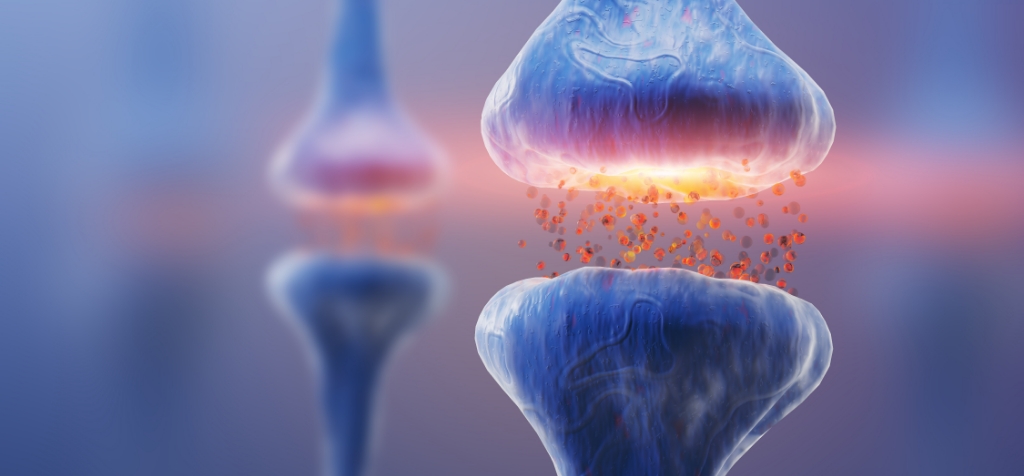
Did you know?
The brain has no pain receptors.
It cannot hurt, and it does not signal a deficiency with pain either.
What hurts in headaches are the surrounding membranes, vessels, and muscles.
Not every door leads to the same destination
The intestinal wall does not have one door, but several. Which one a substance takes determines its further path.
Small water-soluble molecules slip between the cells or are ushered in via transporters. Both routes lead into the portal vein, meaning first to the liver, which immediately converts part of the load again.
Fat-soluble substances take a different route. Bile acids package them into tiny droplets, the micelles. The intestinal cell absorbs them and builds them into transport particles, which are first released into the lymph. Only from there do they enter the blood, bypassing the liver. For this, however, they need fat in the meal, which is why good supplements advise taking them with a meal containing some fat.
“As long as it gets into the blood” is therefore only half the story. For DHA and for fat-soluble vitamin C, this very detour via the lymph is the reason why they arrive intact where they are needed.
The blood-brain barrier is the strictest gatekeeper
Once a nutrient has passed through the intestine, it is in the blood. But that does not mean it is in the brain by any means.
The blood-brain barrier is not an organ that could be dissected out. It is the entirety of the vessel walls in the brain: around 600 kilometers of the finest capillaries, whose cells lie so tightly together that practically nothing seeps through between them. Every molecule has to pass through the cells, not around them. This is exactly why your brain works so remarkably steadily: the barrier keeps fluctuations in the blood away from the most sensitive tissue in your body.
Who gets in and who stays outside
There are essentially two ways in.
Passively, by diffusion. Small, fat-soluble molecules dissolve in the fatty layer of the vascular cells and migrate through. The smaller and more fat-soluble, the easier. As a rough guideline, a size below about 500 daltons applies.
Actively, via transporters. There are specialized gates for essential water-soluble substances. Glucose enters via the GLUT1 transporter, independently of insulin; amino acids use their own systems. These gates recognize a specific molecular shape and take only that along.
Everything else stays outside. A look at pharmaceutical research shows just how consistent this is: according to the much-cited assessment by William Pardridge, more than 98 percent of all small-molecule substances fail at the blood-brain barrier (Pardridge, Neurotherapeutics 2005), even though they were specifically developed for the brain. The barrier is not picky; it is uncompromising.
For you, this means: the crucial question is not how much of a nutrient is in the capsule. It is whether its form is an entry ticket at all.
The vitamin C case: why the form matters
Vitamin C is a good example because almost everyone knows it and almost no one knows the catch.
Vitamin C contributes to the normal function of the nervous system*, it contributes to the protection of cells from oxidative stress*, and to the reduction of tiredness and fatigue*. For an organ with a constantly high oxygen turnover, this makes it one of the most interesting nutrients of all.
But: ascorbic acid, the classic form, is water-soluble. It moves excellently in an aqueous environment, but the lipid layers of cell membranes, the myelin sheaths, and the fatty areas of the retina are difficult terrain for it to access. The body helps itself with its own transporters, but their capacity is limited. Beyond a certain point, more ascorbic acid does not mean more vitamin C where the fat structures are located.
This is exactly where the fat-soluble form comes in. Ascorbyl-6-palmitate is vitamin C to which a fatty acid residue has been coupled. This does not change the nutrient, but rather its entry ticket: the fat membrane recognizes it as something that belongs to it and lets it pass. Initial studies on nerve tissue indicate that this form reaches areas that remain closed to the water-soluble variant (PubMed 12595755; review on vitamin C in the brain: PMC5537779).
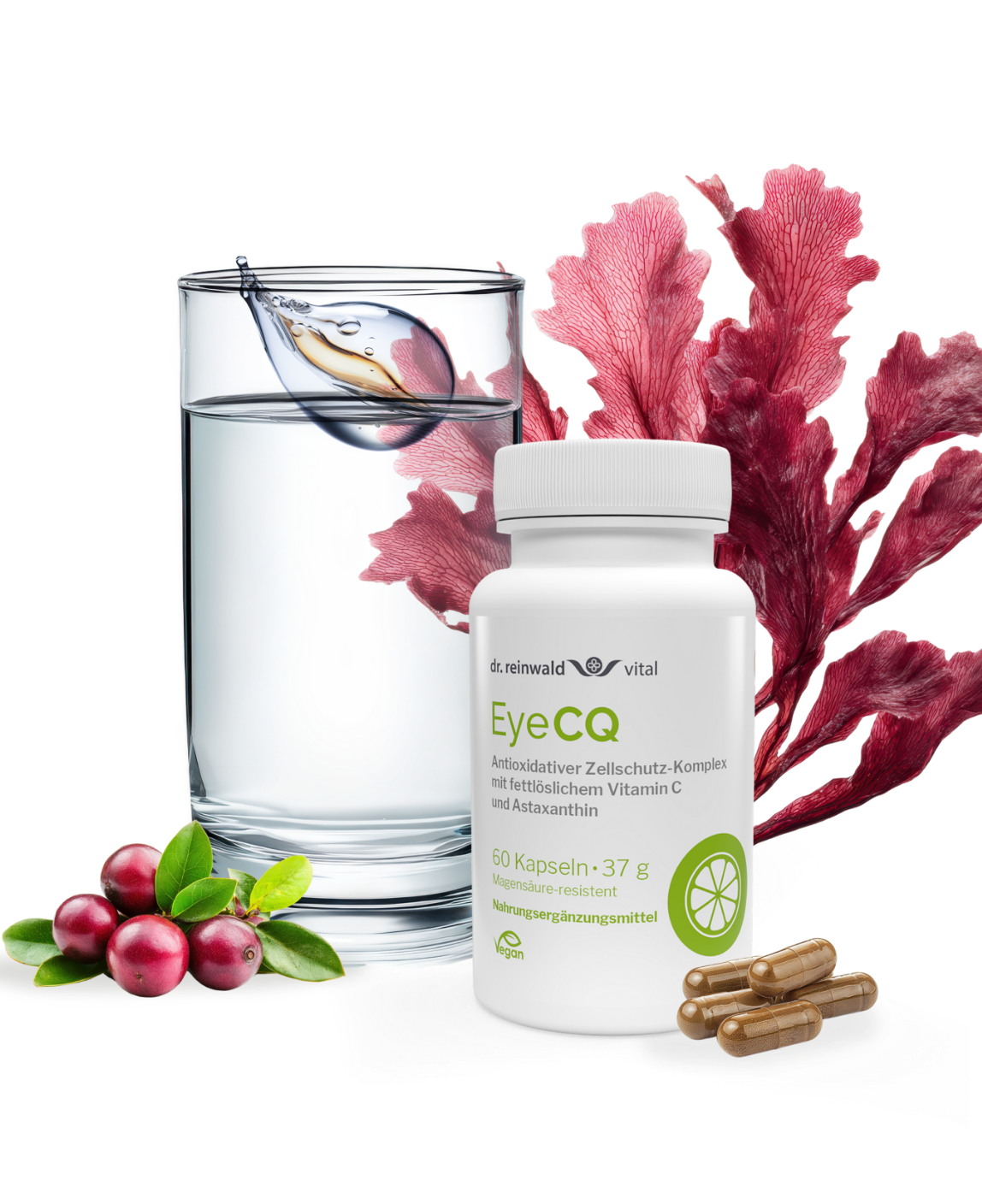
EyeCQ is the answer to precisely this biological problem: water-soluble and fat-soluble vitamin C combined, 500 mg per daily serving (625% NRV), plus astaxanthin from the microalga Haematococcus pluvialis, coenzyme Q10, and reduced glutathione as natural companions.
Astaxanthin follows the same logic as fat-soluble vitamin C. Carotenoids embed themselves directly into the phospholipid bilayer of cell and mitochondrial membranes, in other words into exactly the structure we described at the beginning as a double layer of fat molecules.
Why omega-3 is the building material
When it comes to nutrients for the brain, many people first think of energy. The question of structure is more interesting. Your brain will always get energy if necessary; it is very assertive in that respect. It only has building material if you supply it.
DHA, docosahexaenoic acid, is the most important omega-3 fatty acid in the membranes of your nerve cells. It is not a guest there, but part of the construction. Its strongly angled molecular shape keeps the membrane flexible, and only this flexibility allows receptors to change their shape and pass on signals. If DHA is lacking, the body incorporates other fatty acids, and the membrane becomes stiffer (Bazan et al., Molecular Neurobiology).
DHA contributes to the maintenance of normal brain function*, from 250 mg daily. Here it is worth looking at the source: linseed oil, walnuts, and chia provide ALA, a plant-based precursor. The body can produce DHA from it, but only to a very small extent, depending on the study in the low single-digit percentage range (Am J Clin Nutr). Anyone relying on linseed oil supplies themselves with ALA, not reliably with DHA.
DHA is directly available in fatty cold-water fish and in microalgae. The algae are the original source: the fish only got its DHA by eating it.
DHA and your eyes
Your retina is, in developmental biology terms, an outsourced part of the brain and the tissue in your body richest in DHA. In the outer segments of the photoreceptor cells, membrane discs with a high DHA content are stacked. This is exactly where light is translated into a nerve signal (PubMed 28578316). DHA contributes to the maintenance of normal vision*, also from 250 mg daily.
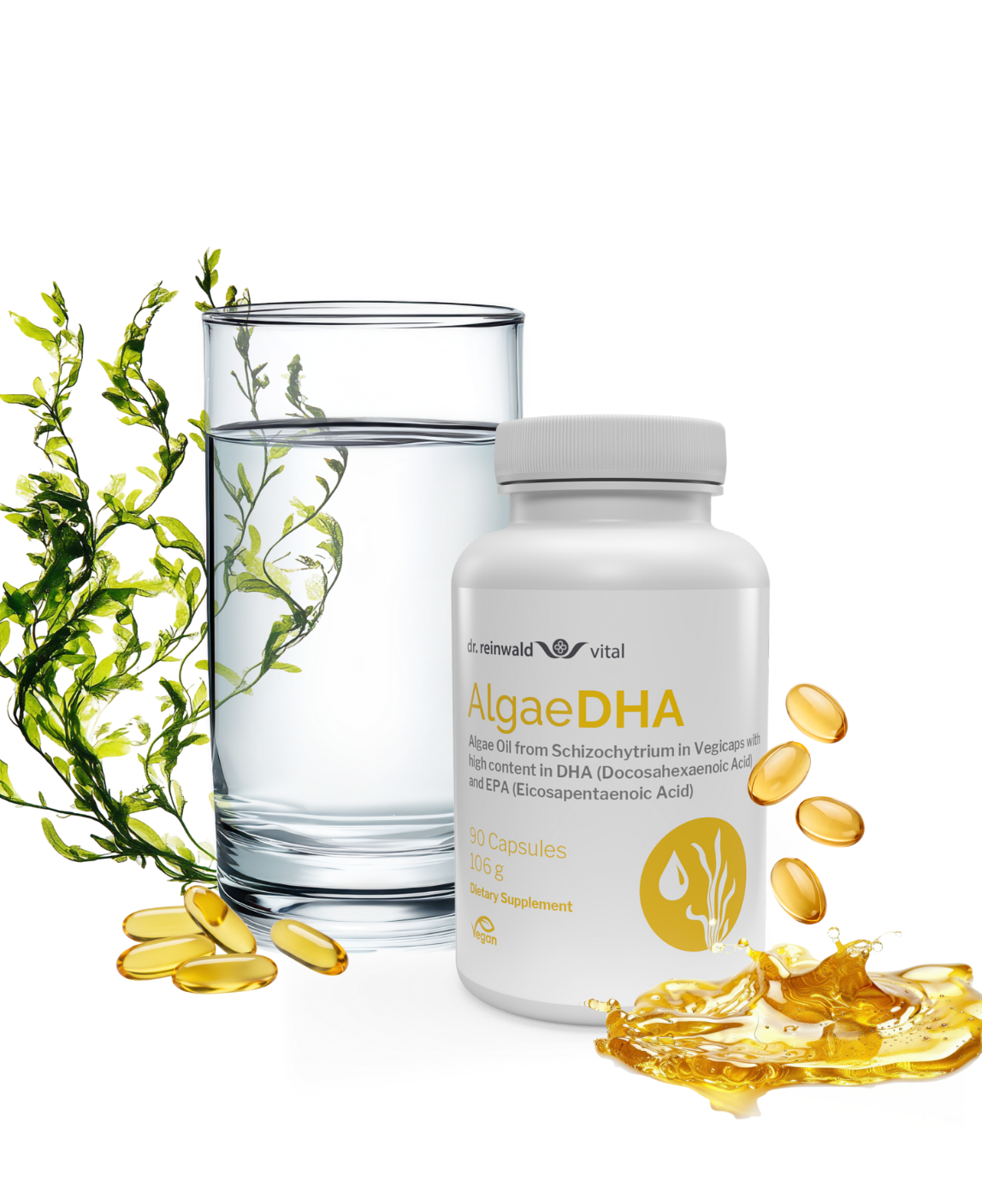
AlgaeDHA provides 750 mg DHA and 375 mg EPA per daily serving from algal oil, in natural triglyceride form, vegan, and from cultivation in a heavy-metal-free environment. DHA and EPA also contribute to normal heart function*.
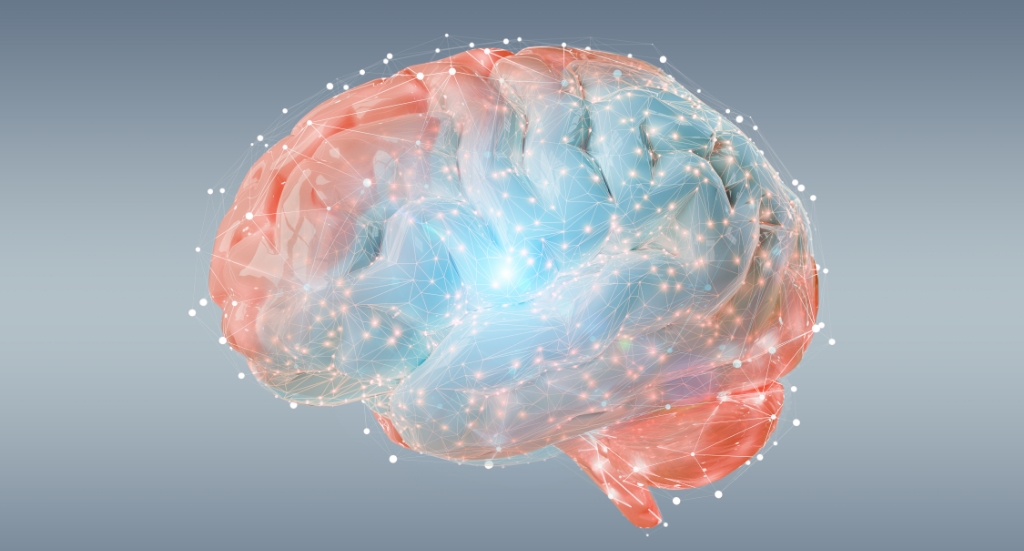
Did you know?
Your brain has no pantry.
Unlike muscles and the liver, it stores practically no energy.
It lives on what is arriving right now, minute by minute. That is why a fluctuating supply becomes noticeable there faster than elsewhere.
Can the brain “calcify”?
The term persists stubbornly and is misleading. No limescale is deposited there as in a kettle. What changes over the years is more subtle and has to do with fat.
Fat structures are chemically vulnerable. Unsaturated fatty acids, especially flexible ones like DHA, are sensitive to oxidative stress. In addition, blood flow in the finest vessels declines and membranes become stiffer with age. So it is not calcification, but a gradual change in the building substance.
This explains why antioxidant nutrients are so obvious for an organ made of fat. Vitamin C contributes to the protection of cells from oxidative stress*, and its fat-soluble form gets to where the sensitive structures are located. Astaxanthin, coenzyme Q10, and glutathione are natural companions in this field and have been deliberately included in EyeCQ.
How you notice an undernourished head
There is no alarm that goes off. Rather, it is a slow decline that people often explain away in other ways.
Concentration no longer lasts as long. After two hours at the screen, thinking feels sluggish. Names and words take a moment longer. A diffuse “fog,” especially in the afternoon. The eyes tire more quickly, and focusing takes longer.
All of this can have many causes: sleep, stress, lack of fluids, screen time, stage of life. If such changes appear for the first time, become stronger, or worry you, they should be clarified by a doctor. A dietary supplement does not replace that. But it can help secure basic supply so that your brain has the building blocks it works with.
Three myths that stubbornly persist
“More helps more.” Not with a barrier that sorts by form. What does not get through will not get through in double the amount either. The question is not milligrams, but the entry ticket.
“As long as it’s vitamin C.” Water-soluble and fat-soluble forms reach different areas in the body. For fat structures such as the brain and retina, the fat-soluble form is the more suitable answer.
“The brain needs sugar.” Your brain needs glucose, that is true. But it does not need sugar on your plate. Dextrose provides a brief spike, after which the rise in insulin pushes the level back down. Your body produces glucose itself when needed via gluconeogenesis and also uses ketone bodies as an energy source. The need for glucose is real; the need for dietary sugar is not.
In short
A nutrient’s journey into the brain has two gatekeepers: the intestinal wall and the blood-brain barrier. Neither asks about the amount, but about the form. Water-soluble substances reach aqueous areas, fat-soluble substances reach fat structures, and your brain is mostly fat structure.
For your head, this means: the right form (fat-soluble vitamin C that reaches the lipid layers), the building material (DHA in the nerve cell membranes), and the antioxidant framework for an organ with high oxygen turnover.
This exact combination is found in the Focus & Resilience Package with EyeCQ and AlgaeDHA. Discover the Focus & Resilience Package now
Frequently asked questions
Small, fat-soluble molecules cross the blood-brain barrier passively. Water-soluble substances need their own transporters, such as glucose via GLUT1. For the brain’s fat structures, fat-soluble nutrients such as DHA and fat-soluble vitamin C are particularly well suited.
It is the tight lining of all blood vessels in the brain, around 600 kilometers of the finest capillaries. Its cells lie so close together that nothing seeps through between them: every substance has to pass through the cells. This is how the brain keeps fluctuations in the blood at bay.
The brain, nerves, and retina consist largely of lipid layers that water-soluble vitamin C reaches only to a limited extent. Ascorbyl-6-palmitate is accepted by fat membranes and arrives where the water-soluble form reaches its limits. Vitamin C contributes to the normal function of the nervous system*.
DHA is a structural building block of nerve cell membranes and keeps them flexible, which is a prerequisite for signal transmission. DHA contributes to the maintenance of normal brain function and normal vision*, from 250 mg daily.