Taking a closer look at microplastics
Where are the artificial particles found, and what can be done about them?
We have long been living in a world made of plastic: plastic bags, plastic bottles, plastic toys… plastic everywhere you look. But what about the smallest plastic particles – so-called microplastics? Are they just as widespread? What about their health effects and: How can we protect ourselves from them?
Is it all microplastic, or what?
To get closer to the topic of microplastics, it is first absolutely essential to understand what exactly lies behind this term. Because unlike immediately recognizable plastic, these tiny pieces of plastic are generally not visible to the naked eye. So it is hardly surprising that these small artificial pieces are smaller than 1 micrometer and are therefore also called nanoplastics.
In addition to the obligatory plastic, other chemical ingredients such as bisphenol A or various plasticizers can also be found, making products lighter, more flexible, or more shatter-resistant.
The crux of the matter: These substances have long been suspected of being harmful to health or even carcinogenic. A worrying piece of news, especially when you know that there are so-called primary and secondary microplastics.
So we speak of…
- Primary microplastics, when plastic pellets in fine or liquid form are used for a specific product purpose.
Examples: cosmetic products, household cleaners, FFP2 masks… - Secondary microplastics, when larger plastic parts, for example from plastic bags, break down into their original form
Examples: abrasion from car tires, plastic waste decomposing due to sun and water…
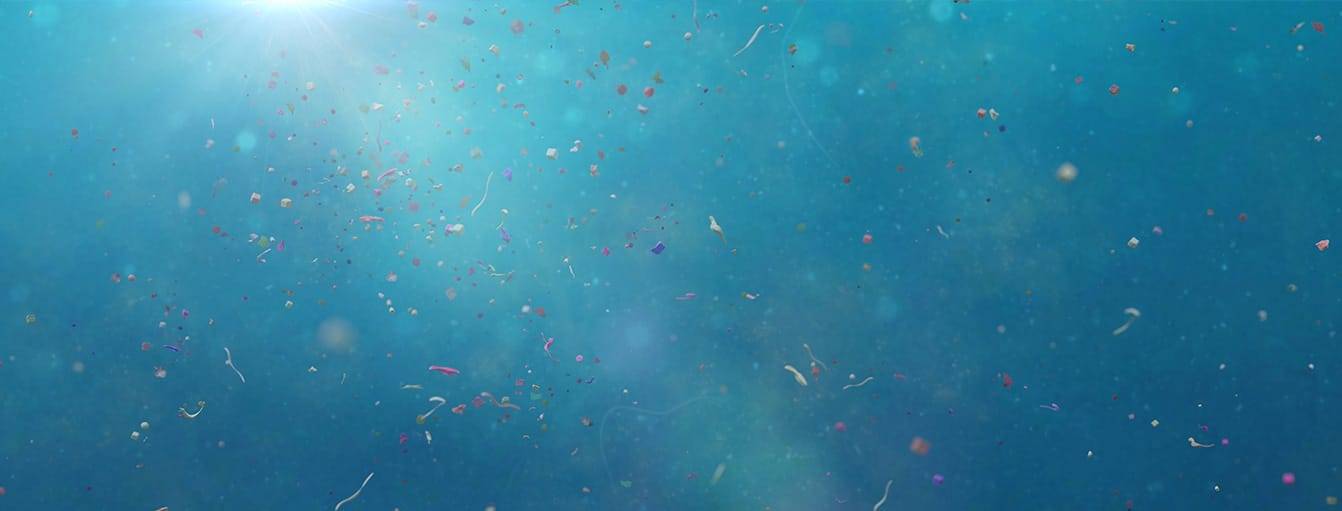
Life is Plastic?
Did you know? These sizes apply to the official classification of…
Nanoplastics: 1 nm – 1 µm
Microplastics:1 µm – 1 mm
Mesoplastics: 1 mm – 1 cm
Macroplastics: 1 cm – 100 cm
I spy with my little eye something you don’t see…
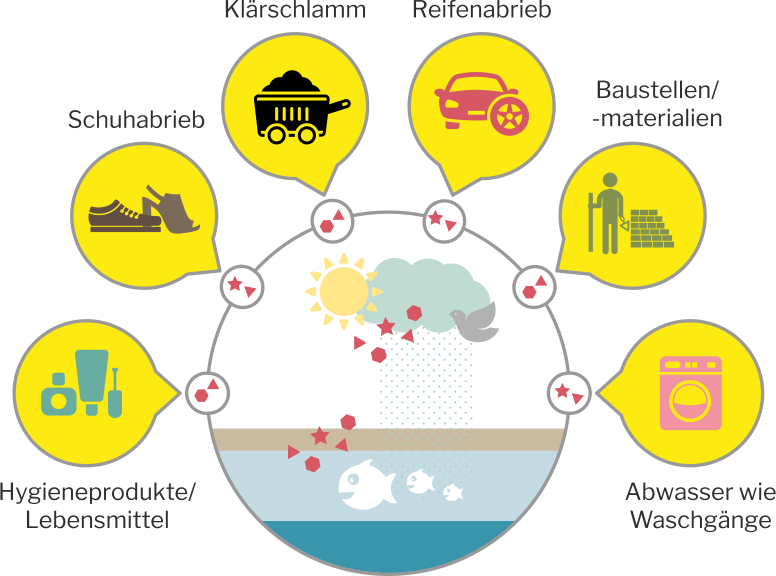
Just because you can’t see it doesn’t mean it isn’t there! Unfortunately, this fact applies 100% to microplastics. Especially when you know about the immense spread of secondary microplastics:

The logical conclusion? Microplastics inevitably enter our environment. Starting with the oceans and our groundwater, all the way to our air and precipitation, such as in the form of snow, as Russian researchers were also recently able to prove. Decomposition caused by the sun also plays its part in releasing microplastics into nature.
The consequence: Microplastics therefore inevitably enter our human food chain. Not only do fish and marine animals ingest the tiny particles, we unfortunately also take in microplastics through the air we breathe and the water we drink. The health consequences for us? Official bodies, such as politicians or various lobbyists, are still hotly debating this and pointing to a lack of scientific studies and reliable data. However, common sense alone clearly says: This cannot possibly be healthy and must have health consequences. Primary microplastics that contain substances such as BPA, which is officially considered potentially harmful to health, must inevitably also lead to health problems.
Keep your eyes open when shopping!
To give you a sense of which products may contain primary microplastics, we have put together a short list for you. This makes it easier for you to look out for a microplastic-free alternative. Because: There are definitely ways to avoid them.
Here is another helpful tip. These terms indicate microplastics and help you recognize them directly when shopping: Acrylates Copolymer (AC), Polymethyl methacrylate (PMMA), Polyurethan (PUR), Polyethylen (PE), Polyquaternium (P), Polyethylenterephthalat (PET), Polypropylen (PP), Nylon-12, Nylon-6, Acrylate Crosspolymer (ACS), Polyacrylate (PA), Polystyrene (PS)
These apps also help detect microplastics in products during everyday shopping: Codecheck, Bett the Micro Bead or Replace Plastic App

The solution? Plastic detox!
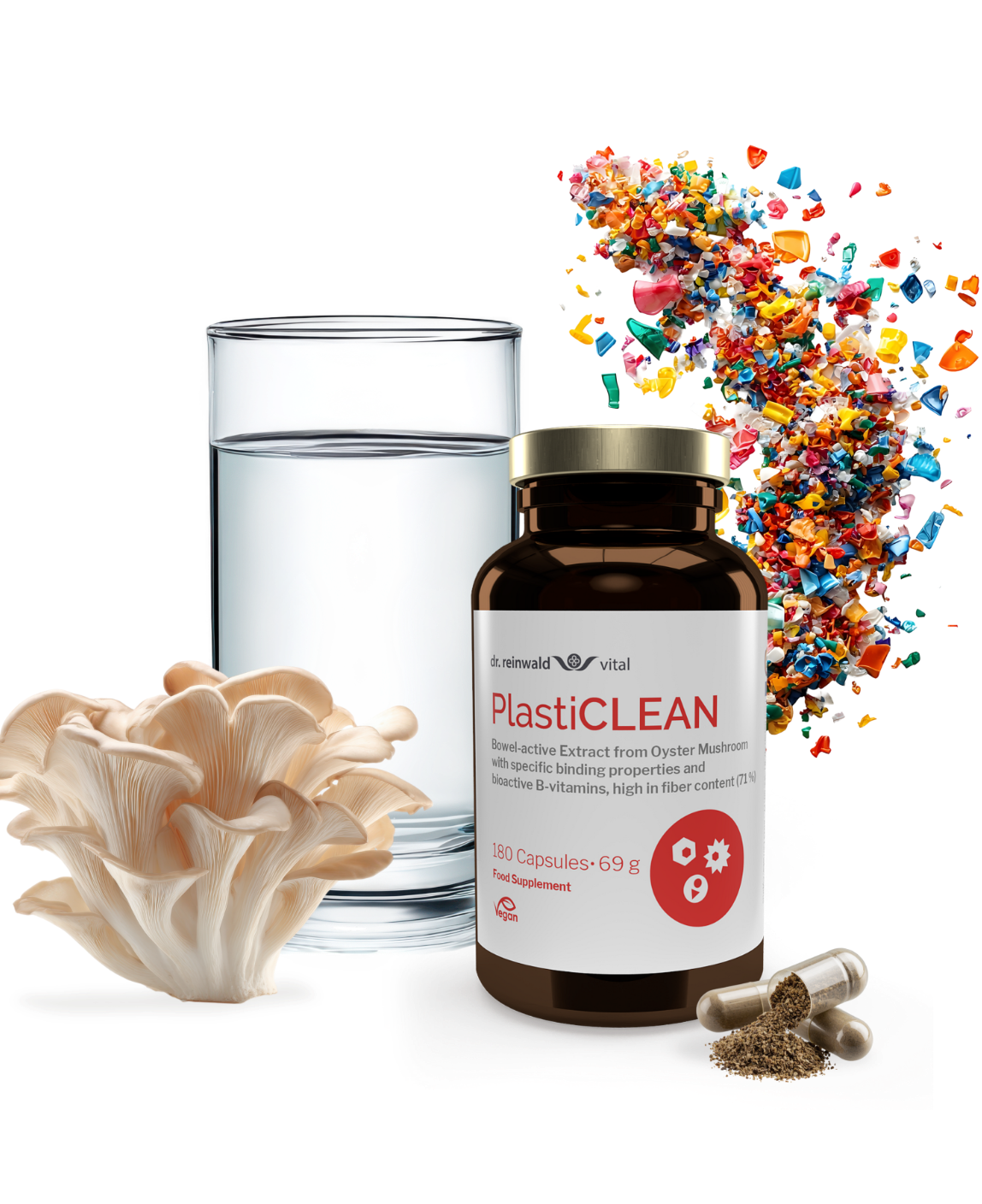
Even if you avoid primary microplastics, unfortunately there is no escaping secondary ones. The tiny nanoparticles are already too widespread in our environment and therefore in our food cycle. The result: Microplastics come back to us humans like a boomerang and, in all likelihood, accumulate in our bodies and in the human gut. To get rid of them again, we have found an effective solution for ourselves: a special chitosan fiber, such as that found in oyster mushrooms! The natural substance chitosan has been used in environmental technology for quite some time, for example for purification. It acts like a kind of “suction cup” and can bind even the smallest particles and help eliminate them. The great side effect is that chitosan also has a natural antimicrobial and antifungal effect and is already used technologically in the preservation of food, fruit and vegetables, animal feed, or in seed treatment.
A clever move that inspired us when developing our product PlastiCLEAN. It contains chitosan-rich oyster mushroom extract as well as many B vitamins and folate, so the body’s own detoxification can be supported gently and effectively.
Are you curious? Then discover our PlastiCLEAN now.
Further links/sources:
- https://www.geo.de/natur/oekologie/plastikverschmutzung-in-sibirien-schneit-es-mikroplastik-30447244.html?utm_source=facebook&utm_campaign=geo_fanpage&utm_medium=posting
- https://www.geo.de/natur/nachhaltigkeit/21483-rtkl-studie-so-viel-mikroplastik-nehmen-wir-jede-woche-zu-uns
- https://www.quarks.de/umwelt/muell/fakten-zu-mikroplastik/
- https://www.bund.net/themen/aktuelles/detail-aktuelles/news/neuere-untersuchungen-zeigen-es-koennte-mehr-mikroplastik-als-kleinstlebewesen-in-den-ozeanen-vorkommen/
- https://www.sutsche.de/gesundheit/mikroplastik-koerper-detektor-1.5040920